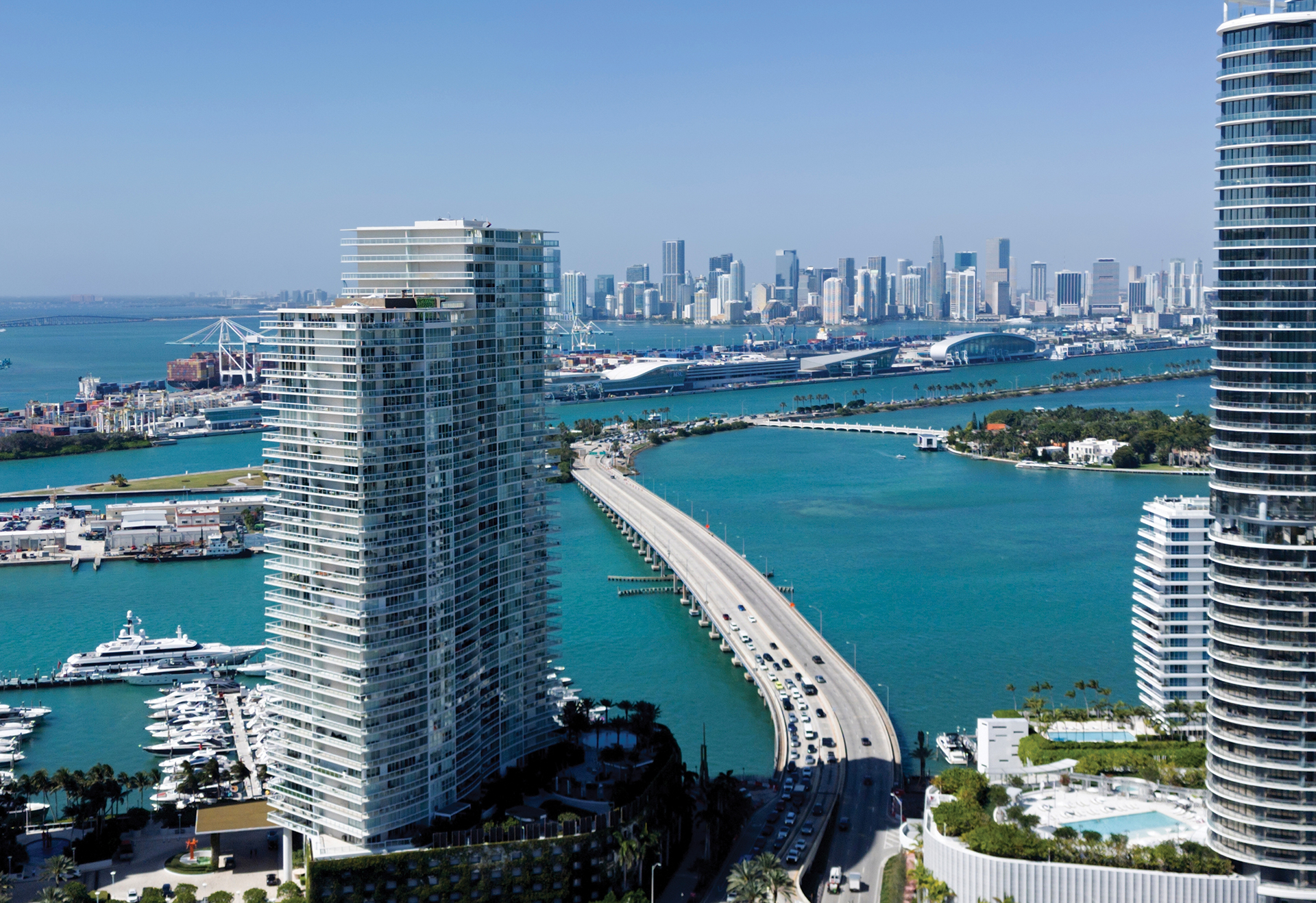
Last quarter marked a turning point, as companies already established in Miami-Dade began driving demand through expansion. The third quarter of 2026 shows that confidence deepening into long-term commitment. Renewals accounted for a far larger share of leasing than usual, tenants committed to new space before construction began, and some of the region's most established institutions announced investments designed to last for generations. That matters because commitments of this kind make demand more durable and give the market a firmer foundation for continued growth.
Leasing held its pace through the summer
Tenants signed approximately 832,000 square feet of leases in the third quarter, in line with the first two quarters of the year and roughly 4 percent below the five-year quarterly historical average. Year-to-date volume of about 2.4 million square feet now runs slightly ahead of last year's pace.
Financial services firms led activity with 32 percent of volume, anchored by Banco Sabadell's 50,000-square-foot renewal at 1111 Brickell, the largest renewal of the quarter. That lease reflected a broader pattern, as renewals and extensions accounted for 42 percent of leased space compared with a five-year average of 33 percent, further reinforcing major companies' long-term commitment to Miami.
Institutions are investing for generations
The quarter's most significant commitments extended well beyond office leases. Banco Santander, which has operated in Miami for more than 30 years, is advancing construction of 1401 Brickell by Santander. In Wynwood, Ken Griffin's landmark $3 billion gift to Carnegie Mellon University will establish a new Miami campus, expected to welcome its first students in 2028.
The broader economy reflects the same confidence. Miami-Dade's August unemployment rate of 2.7 percent was the lowest in Florida, and Miami led every major U.S. market in office attendance relative to pre-pandemic levels through the summer.
Tenants are committing before buildings rise
Demand for new, high-quality space was most visible at Sweetbird North in the Design District, where nearly 95,000 square feet was leased before the building broke ground at quarter-end. That total includes Atria Health Research's 55,000-square-foot commitment, the largest lease of the quarter. New-to-market leasing has now reached 239,000 square feet year to date, well ahead of the 179,000 square feet signed through the same point in 2025.
The flight to quality is also visible in vacancy. Class A Tier I vacancy declined in all four major submarkets, and Brickell's top tier remains below 6 percent. Overall direct vacancy fell to 14.6 percent, 170 basis points below a year ago, as net absorption remained positive at 91,000 square feet and obsolete inventory was removed from the market.
Rents cross a new threshold
Miami-Dade's weighted average asking rate crossed $70 per square foot on a full-service basis for the first time, reaching $70.51, 13 percent higher than a year ago. Class A asking rents rose to $79.91, and Brickell's Class A Tier I rents held above $140 per square foot.
Coral Gables posted the strongest Class A Tier I rent gain among the major submarkets this quarter. Downtown and Miami Airport continue to offer quality space at a meaningful discount to Brickell, giving cost-conscious occupiers strong alternatives in established business districts.
What this means for occupiers and owners
The defining feature of this quarter is the length of the commitments being made. With a construction pipeline equal to less than 5 percent of existing inventory and Brickell's next major delivery not expected until 2029, competition for top-tier space is likely to intensify. For occupiers, early planning is essential, and committing to new construction before it delivers is becoming an effective way to secure the right space. For owners, more than 2 million square feet of active tenant requirements supports disciplined leasing strategies, particularly in buildings that offer the quality and amenities tenants now expect.
Key takeaways
Miami-Dade's office market is moving from expansion to long-term commitment.
• Renewals and extensions accounted for 42 percent of third-quarter leasing, well above the five-year average.
• Tenants are preleasing new construction before it rises, led by nearly 95,000 square feet at Sweetbird North.
• Class A Tier I vacancy declined in all four major submarkets.
• Asking rents crossed $70 per square foot on a full-service basis for the first time.
Conclusion
Markets build staying power when companies and institutions begin investing on timelines measured in years rather than quarters. Miami-Dade's third quarter offered clear evidence of that shift, from a record gift to higher education to tenants committing to buildings still under construction. With limited new supply and steady demand, the market is well-positioned for continued leasing activity and measured, sustainable rent growth into 2027.

Share this insight: